
Why FamSteady
The earliest signs aren't loud. They're patterns.
A bill paid twice. A walk that takes a little longer than it used to. Decades of research say these quiet changes speak years before anything shows up in a clinic — if someone is listening. That research is why FamSteady watches what it watches.
Key takeaways
- People later diagnosed with dementia began missing bill payments about six years before the diagnosis, in a study of 81,364 Medicare records.1
- Adults over 60 lose more than $28 billion a year to financial exploitation, most often to someone they know.2
- Walking speed tracks survival closely enough that geriatricians call it the sixth vital sign; a decline in both memory and gait speed raises dementia risk about sixfold.45
- FamSteady watches these signals with a parent's consent, through read-only bank connections and the health data their own iPhone already records. It is not a medical device and does not diagnose.
Signal one — money
The checkbook knows first
When Johns Hopkins researchers linked 81,364 Medicare records to credit data, they found something remarkable: people who went on to be diagnosed with dementia started missing bill payments six years before their diagnosis — and slid into subprime credit two and a half years before anyone wrote the word in a chart.1 It was the only condition they studied that showed up in money first.
It starts small: a duplicate payment, a forgotten bill, an odd purchase, a generosity that doesn't fit. Confusion with money isn't carelessness — it's often the first symptom anyone could have seen.
“The first place to look for dementia is in the checkbook.”

What 81,364 Medicare records showed¹
- Missed payments begin6 years before diagnosis
- Credit scores slip2.5 years before diagnosis
- Clinical diagnosisYear 0
years before diagnosis that missed payments begin
JAMA Internal Medicine¹
stolen from adults 60+ every year — 72% by someone they know
AARP / NORC²
one-year rise in reported elder fraud losses ($4.9B in 2024)
FBI IC3³
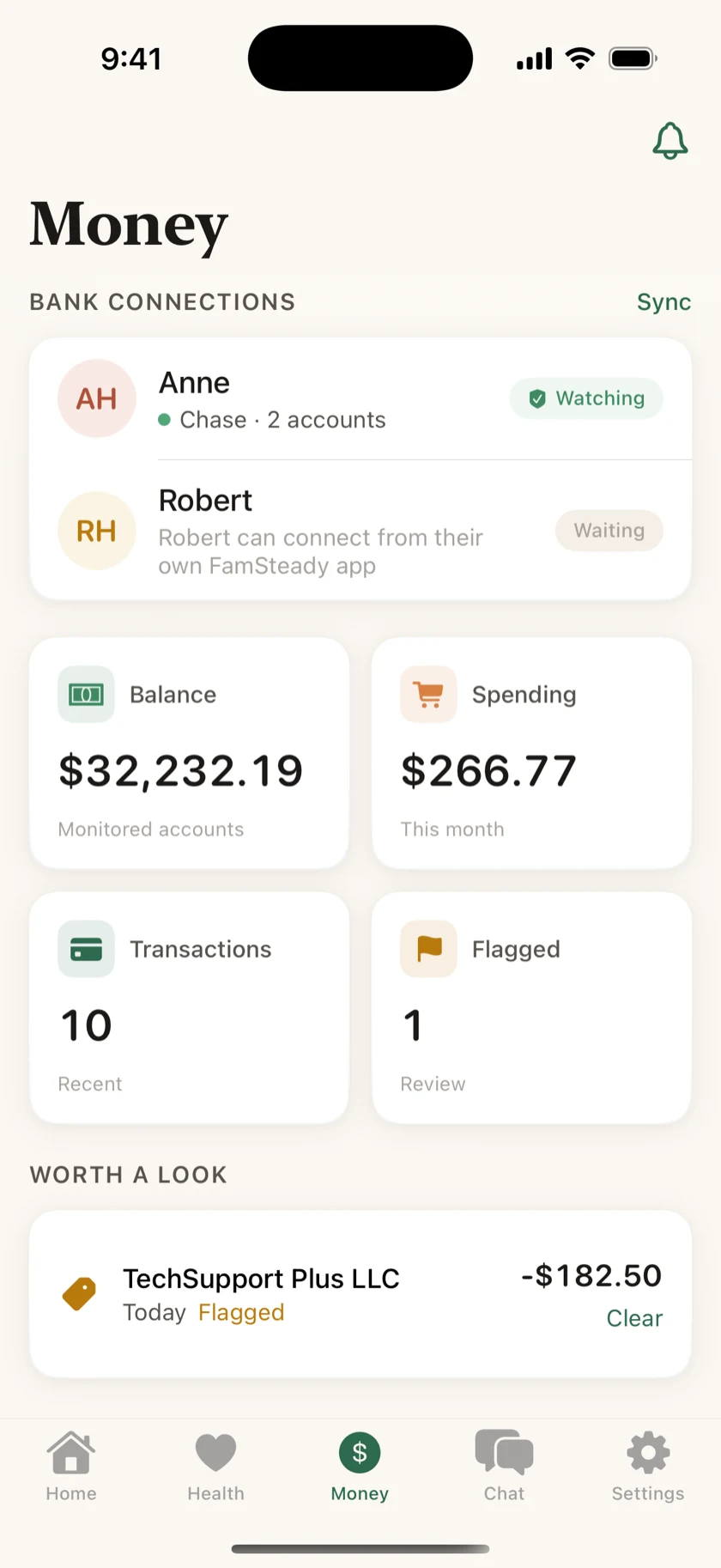
What FamSteady does with this
Money watch learns your parent's normal — then quietly flags duplicates, unfamiliar merchants, and patterns that don't fit. A double-paid utility bill isn't a catastrophe; it's a data point. Three of them is a conversation worth having — with a doctor, or just with Dad, gently, years earlier than the alternative.
And because most theft comes from familiar faces, not strangers,2 read-only monitoring that a whole family can see is itself a guardrail.

Signal two — movement
Walking is a vital sign
Geriatricians call gait speed “the sixth vital sign” for a reason: in a pooled analysis of 34,485 older adults, how fast someone walks predicted how long they would live — every 0.1 m/s of walking speed was tied to roughly a 12% difference in survival.5 Daily movement tells the same story: older adults in the most active quartile carry about half the mortality risk of the least active.6
And the signal runs deeper than lifespan. When walking slows and memory slips together, dementia risk multiplies six-fold — far beyond either change alone.4 A slowing stride is one of the earliest, most honest indicators the body offers. The phone in your parent's pocket already measures it — walking speed, step length, and double support time, the fraction of each stride with both feet on the ground, which creeps upward as balance fades.7
Weekly step average — one year
illustrative
One slow week is life. A quiet three-month drift is a pattern — the kind FamSteady raises gently, long before it becomes a fall or a diagnosis.
higher dementia risk when gait speed and memory decline together
JAMA Network Open⁴
difference in survival associated with each 0.1 m/s of walking speed
JAMA, 34,485 adults⁵
steps a day where longevity benefit peaks for adults 60+ — roughly half the mortality risk of the least active
The Lancet Public Health⁶
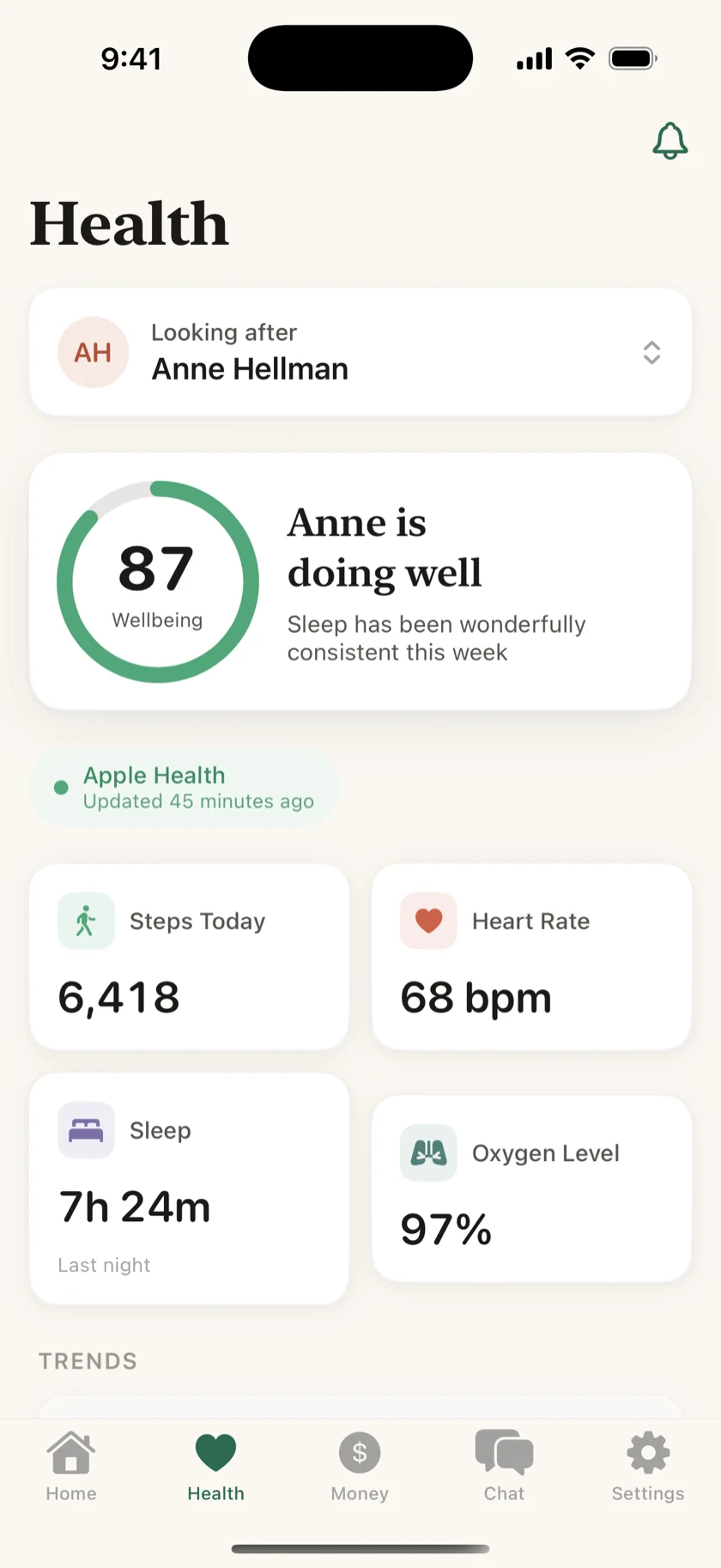
What FamSteady does with this
FamSteady reads the rhythms your parent's own devices already record — steps, walking metrics, sleep, heart rate — and learns their personal baseline. It doesn't chase one slow afternoon. It notices the three-month drift, the mornings that start later, the stride that's quietly shortening.
Then it does the gentlest possible thing: it tells the right person it's worth a look. A check-in call. A walk together. A mention at the next appointment — while it's still early enough for all of those to matter.
Early doesn't just mean sooner. It means options.
Caught early, a financial slip becomes a conversation instead of a crisis — time for a doctor's visit, a power of attorney signed calmly at the kitchen table, guardrails on the accounts before anything is lost. A slowing walk becomes physical therapy, a treatable cause found, a fall that never happens. The research is clear that the signals are there years ahead. What's usually missing is someone watching for them — kindly, and without making anyone feel watched.
What to do with this
The research is the reason; the guides are the how. Each one stands on its own, whether or not you ever use FamSteady.
References
- 1.Nicholas LH, Langa KM, Bynum JPW, Hsu JW. Financial Presentation of Alzheimer Disease and Related Dementias. JAMA Internal Medicine, 2021;181(2):220–227. Cohort of 81,364 Medicare beneficiaries. Source
- 2.AARP & NORC at the University of Chicago. The Scope of Elder Financial Exploitation: What It Costs Victims, 2023. Source
- 3.FBI Internet Crime Complaint Center (IC3). Elder Fraud Report, 2024. 147,127 complaints from victims 60+, $4.885B reported losses. Source
- 4.Tian Q, et al. Association of Dual Decline in Memory and Gait Speed With Risk for Dementia Among Adults Older Than 60 Years. JAMA Network Open, 2020;3(2):e1921636. Meta-analysis of 6 cohorts, 8,699 participants. Source
- 5.Studenski S, et al. Gait Speed and Survival in Older Adults. JAMA, 2011;305(1):50–58. Pooled analysis of 9 cohorts, 34,485 adults 65+. Source
- 6.Paluch AE, et al. Daily steps and all-cause mortality: a meta-analysis of 15 international cohorts. The Lancet Public Health, 2022;7(3):e219–e228. 47,471 adults. Source
- 7.Apple Inc. Measuring Walking Quality Through iPhone Mobility Metrics, 2022. Defines walking speed, step length, double support time, and walking asymmetry. Source
FamSteady is not a medical device and does not diagnose any condition. The research above describes population-level associations; individual changes in finances or mobility can have many causes. FamSteady's role is to surface patterns worth discussing with family and clinicians.